

Walk into any well-run business and the floor is usually the last thing you notice. That's rather the point. A tired, patched-up floor pulls attention away from everything you've worked hard to build, while a floor that simply performs, day after day, lets your business get on with doing what it does best.
That's the appeal behind commercial polished concrete floors, and why we're seeing more UK businesses, from independent retailers to national office fit-outs, choosing it over carpet tiles, vinyl or resin. At Refined, we've fitted polished concrete into offices, showrooms, retail units and restaurants across the North West, and this guide brings together everything we think a business owner or facilities manager genuinely needs to know before making the decision, from how the process works to which finish suits your sector best.
If you'd rather skip ahead and talk to someone directly, our team is always happy to talk through our flooring services and what's realistic for your space.
Polished concrete isn't a coating or a layer laid on top of your existing floor. It's a mechanical process applied directly to the concrete slab itself, whether that's a brand-new pour or a floor that's already been down for twenty years.
The process works through progressive diamond grinding: a series of increasingly fine diamond-segmented tools that refine the surface in stages. A chemical densifier is applied partway through, which hardens the concrete and closes off its natural porosity. The result is a dense, seamless floor with no joints, no grout lines and no separate wearing layer to eventually peel or scratch through, finished to whatever level of sheen suits the space, from a soft matte look through to a high-gloss, light-reflective finish.
Because the process refines the slab that's already there, it's fundamentally different from a resin or vinyl covering. There's nothing sitting on top of your floor that can delaminate, chip or need replacing every few years; you're improving the floor itself. Our concrete floor polishing service covers this full process from assessment through to final seal.
The appeal isn't just aesthetic, though it's certainly part of it. For most of our commercial clients, the decision comes down to a handful of practical advantages that stack up over the life of the floor.
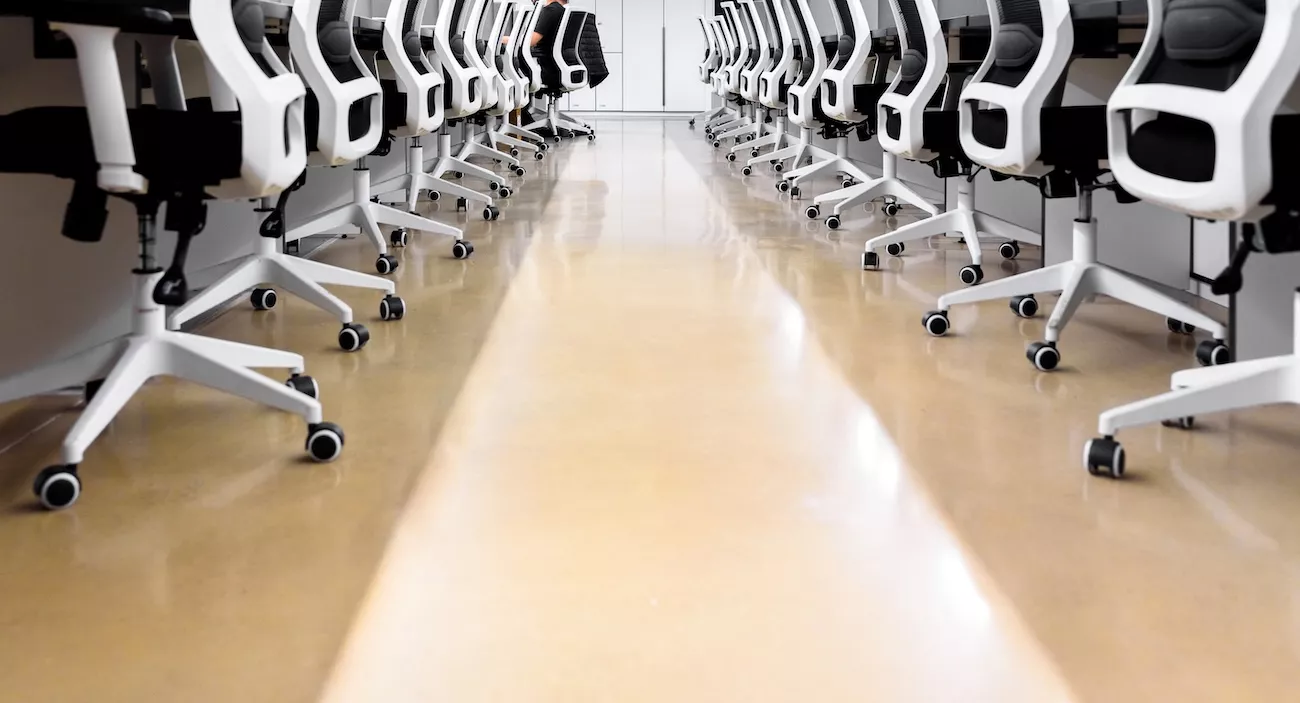
Commercial floors take a battering that a domestic floor never sees: constant foot traffic, trolleys, chair castors, delivery pallets, occasionally a forklift. Polished concrete is built to shrug this off. Because the densifying process hardens the slab from within rather than relying on a surface coating, there's no wearing layer to erode. Where carpet tiles or vinyl typically need replacing every five to ten years in a busy commercial setting, a properly installed and maintained polished concrete floor can perform well for decades.
There's no stripping, waxing or recoating cycle to budget for. A daily sweep or dust mop and an occasional damp mop with a neutral cleaner is genuinely all it takes to keep the floor looking sharp. For businesses managing cleaning contracts across multiple sites, that's a meaningful reduction in both labour and product costs over time.
First impressions matter, and a floor that reflects light well makes a space feel brighter, larger and more considered before a client or customer has even looked up. Polished concrete lends itself naturally to that clean, contemporary aesthetic that so many modern offices, showrooms and retail brands are aiming for, and the finish can be tailored, from the level of aggregate exposure to the final gloss level, to suit the identity of the space.
It's a fair question, and one we get asked often: doesn't a glossy floor mean a slippery floor? In practice, properly finished polished concrete meets commercial slip-resistance standards. The grinding process leaves a surface with genuine microscopic texture, and where a space needs additional grip, whether that's a kitchen, an entrance lobby exposed to rain, or a warehouse floor, we can adjust the finish or add anti-slip treatments to suit.
Because the process works with the concrete slab you already have, there's no new flooring material to manufacture, transport and eventually landfill. It contains no VOCs once cured, supporting healthier indoor air quality, and the thermal mass of concrete helps moderate a building's temperature, which can contribute to lower heating and cooling costs over time. For businesses working towards sustainability targets or green building accreditation, that's a genuine point in its favour.
The process itself follows a consistent sequence, whatever the size or type of commercial space:
For a commercial unit, installation timelines vary depending on the size of the space, the condition of the existing floor and the finish specified, and we'll always give a clear, realistic schedule before work begins so it can be planned around your business hours with minimal disruption. Full detail on the process and finish options is available on our polished concrete floors service page.
One of the most common misconceptions we come across is that polished concrete only works if you're pouring a brand-new floor. That's simply not the case, and it's worth understanding both routes before deciding what's realistic for your building.
If you're fitting out a new unit or extending an existing one, specifying the concrete mix and finish from the outset gives the most control over the end result. It also tends to be the more straightforward route, since there's no existing surface condition to work around.
Most businesses aren't starting from a blank slab, though, and that's where an existing floor can often be transformed without the disruption of a full repour. If the base concrete isn't suitable for direct polishing, whether that's due to its condition, thickness or composition, an overlay system builds a new polishable surface on top, giving you the same durability and finish without tearing out what's already there. It's typically faster to install and far less disruptive to a trading business than starting again from scratch. Take a look at our polished concrete overlay systems to see whether this route suits your building.
Polished concrete performs differently depending on how a space is used, and the right specification, finish level and preparation vary by sector. Here's how it typically works across the commercial environments we fit most often.
Office floors need to handle a constant flow of foot traffic and rolling chair castors without showing it, while still looking sharp enough to make the right impression on clients and staff alike. Polished concrete's seamless, hard-wearing surface holds up to daily wear far better than carpet tiles, without ever needing the periodic replacement that comes with soft flooring. See how we approach polished concrete flooring for offices.
In retail, the floor does more than get walked on: it's part of how customers experience your merchandising and lighting. A polished finish bounces light back into the space, helping products stand out and making smaller units feel more open, all while standing up to the footfall a busy shop floor brings. Explore our polished concrete flooring for retail units.
Whatever you're displaying, whether that's vehicles, furniture or high-end products, the floor is part of the presentation. A high-gloss polished concrete finish creates that clean, gallery-like backdrop that lets what you're selling take centre stage, while standing up to constant browsing traffic and the occasional dropped tool. Find out more about our polished concrete showroom flooring.
Hospitality floors face a tougher brief than most: spills, heat from the kitchen pass, and the need to look genuinely inviting to seated guests, sometimes all within the same room. Polished concrete's non-porous, sealed surface resists staining and heat far better than many alternative finishes, while giving restaurants and bars that warm, contemporary look so many are aiming for. Read more about our polished concrete flooring for restaurants.
Cost depends on a handful of factors: the size and condition of the existing floor, whether you're polishing an existing slab or installing an overlay, and the finish level specified. As a general guide, commercial polished concrete typically works out competitively against premium alternatives once you factor in its lifespan and the maintenance costs it avoids further down the line.
For a full breakdown of UK pricing, including per-square-metre figures for different finishes and floor conditions, our dedicated cost guide covers this in detail.
Keeping a polished concrete floor looking its best is refreshingly simple:
That's it. No stripping, no waxing, no specialist equipment required for day-to-day care.
We've built our reputation across the North West on getting commercial polished concrete right, from small independent retail fit-outs to larger office and hospitality projects. As a specialist contractor rather than a general flooring firm, polished concrete and overlay systems are what we do, not one line among dozens on a services list, and that focus shows in the finish we deliver and the way we plan around a live business.
Whether you're weighing up a new installation or wondering whether your existing floor is a good candidate for restoration, we're happy to talk it through. Take a look at our flooring services or get in touch for a free, no-obligation quote.
With proper installation and basic maintenance, commercial polished concrete floors commonly perform well for decades. Because the process hardens the slab itself rather than relying on a surface coating, there's no wearing layer to replace, which is why so many businesses see it as a long-term investment rather than a recurring cost.
No. A properly finished polished concrete floor meets commercial slip-resistance standards, thanks to the microscopic texture left by the grinding process. Where extra grip is needed, such as in kitchens or entrances exposed to rain, the finish can be adjusted or treated to suit.
Both are possible. An existing slab in good condition can often be polished directly, while floors that aren't suitable for direct polishing can usually be brought up to standard with an overlay system, avoiding the cost and disruption of a full repour.
Costs vary depending on the size of the space, the condition of the existing floor and the finish specified. Our full UK cost guide breaks this down by project type.
Timelines depend on the size of the space, whether you're polishing an existing slab or installing an overlay, and the finish level chosen. We always provide a clear schedule before work starts so it can be planned around your trading hours.
Yes, though the specification differs by sector. Offices and retail units typically prioritise durability and light reflectivity, while restaurants need a finish that stands up to heat and spills. Our sector pages for offices, retail units, showrooms and restaurants go into the detail for each.
Ready for a floor that works as hard as your business does? Get in touch with our team for a free quote, or explore the full range of commercial and residential options across our site.

Extensions and new builds are one of the best entry points for polished concrete flooring, because the finish gets specified at the groundworks stage rather than added on top of an existing floor later.
Find out why restaurants, bars and hospitality venues are choosing polished concrete flooring for its durability and design appeal. Get the facts on cost, hygiene and where it works best in your venue.
Getting three wildly different quotes for a polished concrete floor is common, but the price gap isn't random once you understand what actually drives it. This guide breaks down realistic UK cost ranges for residential and commercial projects in 2026, the key factors that affect your price, and how to get an accurate quote, so get in touch with Refined today for a free, no-obligation quote.
Get a quote

©Copyright Refined. All rights reserved.