

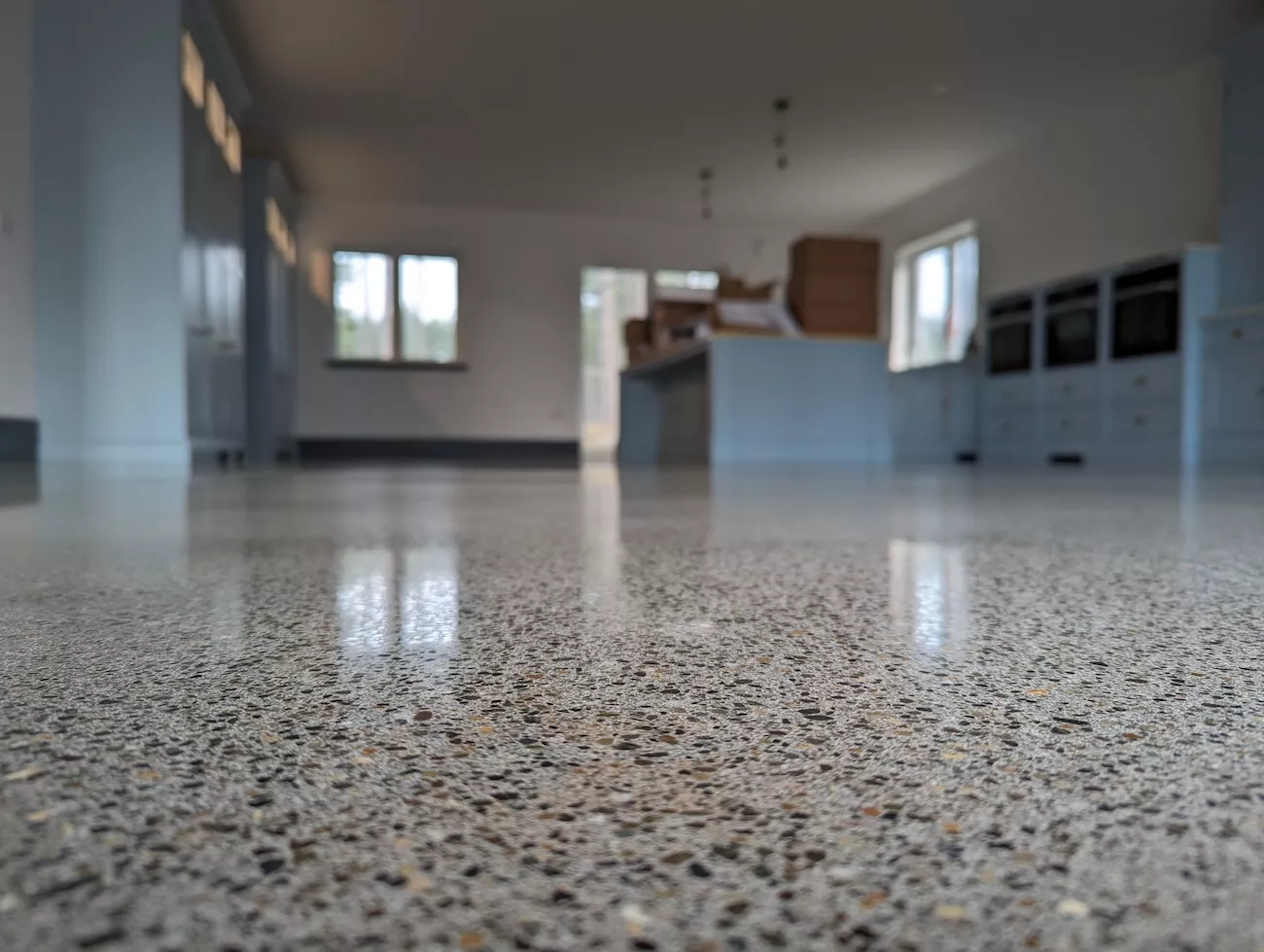
If you want the clean, seamless look of polished concrete, there are two ways to get there: install a polished concrete overlay over your existing slab, or pour new concrete and polish it from scratch. On the surface, they deliver a similar end result. But the route to that result, the cost, the timeline, the disruption, the finish quality can be very different depending on your project.
This guide breaks down both options honestly, so you can make the right call for your space.
A polished concrete overlay is a high-performance, cement-based topping applied directly over an existing concrete slab. Once it has cured, it is mechanically ground and polished through progressively finer diamond tooling stages, in exactly the same way as traditional polished concrete, to produce a smooth, durable, light-reflective surface.
The key distinction is that the overlay itself becomes the finished floor. You are not polishing the old slab underneath; you are polishing a brand-new surface that has been installed on top of it.
Polishable concrete overlays are typically applied at between 3mm and 10mm thick, depending on the system and the condition of the substrate. They can be finished to a range of aesthetics, including a soft cream finish, a salt and pepper texture with fine aggregate visible, or a fuller stone-like aggregate exposure for a more dramatic look. Colour dyes and stains can also be incorporated to achieve a bespoke tone.
The result is polished concrete overlay flooring that looks, performs, and wears like a newly poured polished slab, but without requiring one.
New polished concrete follows a different path. A fresh concrete slab is poured to a specified mix, with carefully selected aggregate, controlled water content, and a mix design suited to the space and its loadings. Once poured, it must cure fully before any mechanical polishing can begin. Depending on the environment and the specification, that curing period is typically a minimum of 28 days.
After curing, the slab is ground, honed, and polished using diamond tooling in progressively finer grits. Concrete densifiers are applied during the process to harden the surface, and a penetrating sealer is applied at the end to protect it.
It is a well-established, excellent flooring system. But the final result depends heavily on what comes out of the pour, the aggregate distribution, the surface consistency, and the absence of defects. That unpredictability is one of the reasons polished concrete overlays have become a popular alternative.
This is often where the decision gets made. New polished concrete starts from scratch, so the pour can be controlled from the outset. Polishing an existing slab, however, means working with whatever is already there.
If the existing concrete is cracked, stained, contaminated with old adhesives, or simply inconsistent in quality, grinding it down may reveal problems rather than solve them. Polishing an old or compromised slab can produce patchy colour, uneven aggregate exposure, and visible repairs in the finished floor, none of which is the look anyone is paying for.
A polished concrete overlay sidesteps this entirely. The existing slab simply needs to be structurally sound. Surface preparation, typically mechanical grinding or shot blasting to ensure a strong mechanical bond, is carried out before the overlay is applied. From that point, you are working with a clean, consistent, newly formulated surface, not the one you inherited.
This makes polishable concrete overlays particularly well-suited to renovation and refurbishment projects, where the condition of the existing substrate is out of your control.
New concrete polishing can produce outstanding results when the pour is well-executed. But polishing existing slabs, especially older ones, is inherently unpredictable. Aggregate may be unevenly distributed. Colour variation can appear once the top layer is ground away. Weak spots and repairs that were invisible before grinding can become prominent features of the finished floor.
Polished concrete overlay floors are designed to be polished. The material is formulated for controlled aggregate exposure, uniform colour, and consistent surface hardness. This makes the finished result far more predictable and repeatable, which matters especially in commercial environments, retail spaces, showrooms, and hospitality venues, where the aesthetic specification is non-negotiable.
Pouring new concrete involves demolishing and removing the existing floor, preparing the subbase, pouring and screeding, then waiting through a curing period before polishing can begin. In a live commercial environment or an occupied residential property, this represents a significant disruption and a lengthy programme.
High-quality polishable concrete overlays are rapid-setting. Depending on the product and conditions, the overlay can be walked on within hours and is typically ready to grind and polish the following day. The overall installation time from start to finish, sealed floor is considerably shorter than a new concrete pour, and the disruption to the space is far lower.
For refurbishment projects, renovations, and any environment where downtime costs money, this is a meaningful practical advantage.
Upfront, a polished concrete overlay is almost always more cost-effective than full concrete replacement. There is no demolition, no skip hire, no structural groundworks, and no extended labour programme. The base concrete beneath an overlay does not need to meet the same premium specification as a slab intended for direct polishing; it simply needs to be sound, which keeps material costs down, too.
Fewer diamond grinding stages are needed because the overlay starts flat, level, and consistent. That means less machine time and lower consumable costs through the polishing process.
New concrete, installed and specified correctly, can offer a longer theoretical lifespan, but the long-term maintenance requirements of both systems are broadly similar, with periodic sealer reapplication needed in either case to keep the surface protected.
The honest answer on cost is this: for most renovation and refurbishment projects, a polished concrete overlay delivers equivalent or better results for a fraction of the overall spend.
Both routes can achieve the full range of polished concrete finishes, from a low-sheen satin to a high-gloss mirror-like surface. Concrete dyes and stains can be used with either system to introduce warmth or tone. Both produce a seamless, joint-free floor that is easy to clean and maintain.
Where polished concrete overlays have a slight edge is in aesthetic control. Because the finish is determined by the overlay material itself rather than by whatever aggregate happens to be present in the original slab, it is easier to specify and achieve a consistent look across the whole floor, including colour, aggregate size, and exposure level.
Both systems are highly durable when correctly installed and maintained. A well-specified new concrete slab, polished and sealed to a high standard, is one of the most long-lasting floor finishes available. A properly installed polished concrete overlay is equally hard-wearing in day-to-day use, in both domestic and commercial environments.
The one consideration with overlays is substrate movement. If the slab beneath shifts or develops significant structural cracking over time, there is a risk that movement will telegraph through to the overlay surface. This is managed through proper surface assessment before installation, thorough crack repair and preparation, and, where movement is a concern, the use of an anti-fracture membrane between the substrate and the overlay. An experienced installer will identify these risks at the assessment stage and specify accordingly.
A polished concrete overlay is likely the right choice when:
New poured concrete is more likely to be the right route when:
We work across homes and extensions, retail and hospitality spaces, offices, showrooms, and commercial refurbishments. Every project begins with a proper assessment of the existing substrate, because getting that right is what determines the quality of everything that follows.
If you are weighing up a polished concrete overlay against new concrete, or if you are simply not sure what your slab is capable of, we are happy to advise. Get in touch with the Refined team for an honest conversation about your project.
Most polished concrete overlay systems are applied at between 3mm and 10mm, depending on the product specification, the condition of the existing substrate, and the desired finish. Your installer will confirm the appropriate thickness as part of the assessment process.
It can, particularly if the substrate beneath moves or develops significant structural cracks after installation. This risk is managed through thorough surface preparation, crack repair prior to application, and the use of an anti-fracture membrane where substrate movement is identified as a concern. Proper installation by an experienced contractor greatly reduces the likelihood of cracking.
When correctly installed and maintained, polished concrete overlays are highly durable and will last for many years in both residential and commercial environments. Reapplication of the protective sealer every few years, or more frequently in high-traffic commercial spaces, helps preserve the surface and extend its lifespan.
Yes. Polished concrete overlay floors are widely used in retail units, restaurants, cafes, offices, showrooms, and hospitality venues. The combination of a fast installation programme, minimal disruption, and a high-quality, low-maintenance finish makes them a practical and popular choice for commercial refurbishment projects.
Concrete resurfacing is a broad term for applying any kind of thin topping to an existing slab. A polished concrete overlay is a specific system formulated to be mechanically polished after application, using the same diamond grinding and sealing process as traditional polished concrete, to produce a smooth, durable, high-quality floor finish.
In most cases, yes. A polished concrete overlay avoids the cost of demolition, removal, disposal, new concrete materials, and an extended curing programme. For renovation and refurbishment projects where the existing slab is structurally sound, an overlay typically delivers an equivalent or superior finish at a significantly lower overall cost. Contact Refined for Polished Concrete Overlay Systems
Refined is a specialist concrete flooring contractors installing polished concrete floors and overlay systems across the UK. View our polished concrete overlay service or get a quote for your project.

Thinking about upgrading your business floor? See why commercial polished concrete is the durable, low-maintenance choice more UK businesses are switching to, and get a free quote from Refined's North West team.
Get a quote

©Copyright Refined. All rights reserved.